
 Is it okay to hate a movie before you’ve seen it? I hated Nick Broomfield’s movie Battle For Haditha from the first few moments into the seven-minute trailer.
But at least one Marine doesn’t think I’m being fair.
Elliot Ruiz is the lead actor in the film. He plays Corporal Ramirez, a character based on the real-life Staff Sergeant Frank Wuterich.
Ruiz was also a real Marine. He served in Operation Iraqi Freedom. The war ended for him in April 2004 when an Iraqi drove a car through barbed wire at a checkpoint, and the wire almost tore Ruiz’s leg apart.
We had a chance to talk this week while he drove his brother, who just graduated from Marine boot camp, to Twenty-Nine Palms.
Defend Our Marines: You know, people, including me, are angry at you.
Elliot Ruiz: Yeah, I’ve been on DefendOurMarines.com. That’s why I wanted to do this interview. The thing is that nobody’s seen the movie yet. From the trailer what they see is a bunch of Marines killing all these innocent people. I want people to understand that this is film isn’t trying to incriminate the Marines.
Defend Our Marines: But your portrayal of the shooting at the white taxi is cold-blooded murder. Your character shoots five Iraqis who have their hands in the air. In reality, the shooting at the white taxi was nothing like your portrayal. SSgt Wuterich was a good distance away: his line of sight was blocked, another Marine almost certainly fired the fatal shots. Forensics and testimony all tend to corroborate statements that the Iraqis were moving away from the car.
Elliot Ruiz: The film is definitely a fictional portrayal. At no point are we blaming the Marines for this. I wouldn’t want to be part of something that gave the Marine Corps a bad name. I saw what the director, Nick Broomfield, was trying to do. Nick wasn’t trying to blame the Marines, Nick wasn’t trying to blame the Iraqis. And it wasn’t just a two-sided story, he also showed how the innocent Iraqis are caught in the middle between the military and the insurgents. So he’s actually showing three stories at once.
Defend Our Marines: I can’t speak for the Wuterich family, obviously, but I think they’d probably appreciate it if you stressed to the media that this is not a true story.
Elliot Ruiz: Obviously, nobody knows exactly what happened. I did an interview on the BBC and I said that nobody would ever know exactly what happened except for the people who were really there. It’s shot as a docudrama style because that’s Nick style: he is a documentary film maker.
Defend Our Marines: You depict deaths inside the houses as well.
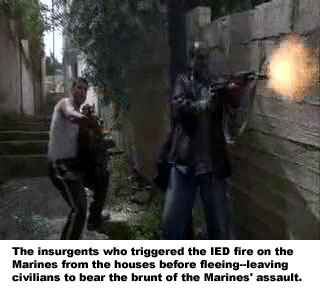
Elliot Ruiz: We show things like a Marine throwing a grenade in a room not knowing that it was full of kids. He wanted to clear the room and make sure his friends were okay. Collateral damage, it happens. It’s war. We’re not going to sugarcoat anything. People died because it’s war. The film shows how some of those deaths might have occurred.
A Marine doesn’t want to kick into a room but there’s people shooting at him. In the film, there are two or three different people shooting at the Marines. They don’t know where the fire is coming from, so, to be safe, they throw a grenade into a room and unfortunately that room might have had kids in it.
But who’s to blame for that?
The great thing about this film is that it brings humanity to the characters. You feel bad for my character, even though it shows him killing the guys in the white taxi. You feel bad for my character because you know deep down it’s not his fault. It’s not his fault that he’s put in this situation.
Nick wasn’t trying to bash the Marine Corps or saying Marines killed all these innocent civilians like Time magazine and that congressman said. It’s real easy for people who sit behind a desk to say something like that. To point their fingers when it doesn’t effect them or their families. Nick wanted to bring humanity to these people even though what happened in the film is an inhumane thing. You feel bad for them and you feel bad for the situation they’re put in.
Defend Our Marines: But the film is still based on false allegations about real people. And that makes it confusing. Anyone watching the film would probably think your portrayal is how it happened.
Elliot Ruiz: Let’s just say that if they did go in and kill those people: who was really responsible? Should Wuterich be really to blame for that? Who put them in that situation? Who is really to blame for all this happening? That’s what we’re trying to get to in this movie.
Defend Our Marines: Well, I find it hard to imagine that Marines massacred people because I haven’t seen any evidence that a crime was committed in Haditha. But if I could imagine it, I would still disagree with you. If a crime was committed, frankly, I’d hold the Marines responsible. And actually SSgt Wuterich himself has taken responsibility for the actions of his squad. In real life, nobody accused of crimes for Haditha is playing the punk card. Blaming higher command or blaming President Bush or Dick Cheney or Donald Rumsfeld is just playing anti-war politics.
Elliot Ruiz: But is it really the Marines fault? If they did do it, is it really their fault?
People don’t know the type of stresses of war we go through. People don’t know the type of war that we’re fighting. In the film we show how an insurgent can set off an IED and walk past you and you don’t even know that was the guy who just killed your friend.
And that’s what this film shows. The media doesn’t show that. The media doesn’t show the types of things we go through. Nobody knows the types of things that we go through. People can only imagine and see what is fed to them on TV, that’s what they see. And that’s what makes this film so great. It gives people a glimpse of the day-to-day life we live out there. Being with friends, losing friends, being put in leadership positions of all these young guys. So now you’re not only stressed out that you might die out there, but the fact that you’re in charge of all these Marines that if don’t get them home to their family, how are you going to feel?
And it also shows how we’re just pawns in this war. How we’re being used, how we’re being manipulated, it also shows how the innocent Iraqis are being manipulated by the insurgents and how they use propaganda videos. And it also shows the type of situations that we’re placed in, the type of decisions we’re forced to make.
And really, who was it that sent us in there? We weren’t like, yeah, we want to go into Iraq, we want to do this. Nobody wants to go and fight, nobody wants to go and kill people. That’s something that no human wants to do. But that’s our job. People have to understand that’s our job. That’s what we do if we have to. We hope that we never have to do something like that, but it happens. It’s war.
Defend Our Marines: Are you following the cases, the trials that have been going on in Pendleton?
Elliot Ruiz: I have friends who are stationed at Pendleton and they’ll call and update me. I go to DefendOurMarines.com. That’s why I was interested that you contacted me. There’s so much on your site to read about. It’s overwhelming with the info.
You know, there’s a lot of films out there I don’t want to mention any names but there’s films out there that are showing the military as machines, they are out there killing, and our film is the opposite of that.
I don’t want to name names, but I saw one film at the Toronto Film Festival that made me sick to my stomach. I was so pissed off. We stood up before the entire audience, myself and another guy in the Haditha film, and we stood up and said this is a disgrace to the military, this is a slap in the face to the military. People are going to see this film and think all Marines and soldiers act like this. It’s just horrible the way the military is depicted in it. Because of the director, and who he was, everybody was in shock that we were talking to him like this. It was a disgrace and we told him.
The media couldn’t even believe it. They started taking notes and taking pictures and he got pissed. He was throwing his arms up and screaming, ‘I did the research!’ and all this other stuff. And we just walked out quietly.
Defend Our Marines: So you are hoping people will take something positive from Battle For Haditha?
Elliot Ruiz: There’s just so much information in the film. I really hope people look past the massacre or that actual scene where my character is killing those people. I hope they really look past that and go see the film and leave with at least an idea of the types of things these Marines go through on a day-to-day basis. The film throws up three sides to one story and it lets people decide for themselves who they feel is responsible for an event that might have happened.
Battle for Haditha will be shown at the Film Forum in New York City from Wednesday, May 7 to Tuesday, May 20.
________________________________________________________